Teacher Stuff: compare contrast

Showing posts with label compare contrast. Show all posts

Close Reading with Sketchnotes

Have you heard of sketchnotes? This visual note-taking technique uses pictures, words, arrows, lines, and doodles to capture a main idea, and you don't have to be an artist to do it! Sketchnotes are not about art, but about triggering both sides of your brain to help you remember important ideas using visual cues to highlight information. This technique requires a deep understanding and synthesizing of information in order to capture the big ideas. 

I see similarities between the concept of sketchnotes and book snaps, one of my new favorite ways of having students interact with text, and I fully intend to mesh these two strategies together this year!

Introducing Sketchnotes to Students

To introduce the concept of sketchnoting to students, we started with a low-stakes assignment where students got to share something about themselves. With a new concept and/or a new tool, it's important to give students time to experiment before asking them to do something that has a lot of heavy content. Think about your level of anxiety if you were in a class that asked you to use a technology tool you had never used before, and you were told you had to complete a high stakes assignment that you would be graded on the first time you ever used it. Yikes! The time spent "playing" around with it so you can figure out how it works is well worth the time spent so you know how to use it later when heavier content is layered in. When you're familiar with the tool you are using to create something, it frees up working memory to focus on your ideas rather than how to use the tool.

We introduced sketchnotes with a short video: Sketchnote Frenzy: The Basics of Visual Note-taking.


I created the sketchnote above digitally proving that you don't have to be an artist to try sketchnoting! I got the idea for the 4Cs sketchnote from Expressive Monkey's Sketchnote Toolbox on TpT. Here is her blog post: The Visual Structure of Sketchnotes.  We began with sharing what we did over the summer through the 4Cs. We started by putting our names in the middle, and in the upper right hand corner, we chose something important we wanted to communicate. In my example, I shared about the opportunity I had to take a tour of Google in Boulder, CO. It was amazing!  In the lower right hand corner, we shared something creative we did. This summer I became Raspberry Pi certified, and I learned how to do a lot of sophisticated programming. My picture shows a Raspberry Pi and the lights I programmed like a stop light. In the upper left hand corner, we shared people with whom we have collaborated. I went to two different conferences this summer, so in my example, I listed the teachers who came with me to those conferences. In the lower left hand corner, we used critical thinking to start brainstorming ideas for genius hour. Students wrote what they were interested in learning more about.

Technology Options for Sketchnotes

If you're using a windows 10 device, these apps are great for sketchnoting:
If you're using an iPad, these are my favorite apps:
  • Paper 53 
  • Book Creator – this is not a drawing app, but it has the potential for adding drawings, pictures, voices, and even videos in an ebook making it a much more dynamic way to create a sketchnote!
  • SeeSaw – this is another tool that is not a drawing app, but it has the potential to add drawings, pictures, voice, and create videos and put them into a digital portfolio. Another great tool for creating dynamic sketchnotes!
  • Pic Collage EDU – this tool is for making collages with pictures, but it also has the ability to add drawings, words, and pictures. Check out this post from Erintegration: Drawing on Pic Collage with A Simple Hack.  
  • Popplet – this is another tool that is not a drawing app–it's actually a visual mind-mapping tool or graphic organizer that has the functionality to add pictures, videos, words, or drawings to organize your thoughts or data. Popplet can be used on the iPad or computer.


If you don't have access to a classroom set of devices or you prefer to write/draw with a pencil and paper, there is still a technology option for you that I'm SO excited about! I recently learned about Rocket books. These notebooks look and feel like real paper that use Frixion Erasable pens or markers (some of my favorite!). You can add your sketchnotes into the notebook, then scan it with the rocketbook app and send it straight to your google drive, dropbox, email, or even send it in a text (which is great for my son when he wants to send his picture to grandma and grandpa!). Once you have saved your sketchnote digitally, put your notebook in the microwave with a mug of water on top of it, and it wipes all the pages clean so you can use them all over again! Amazing! These notebooks are pricer than regular notebooks, but if they hold up, they can be reused over and over by different classes each year. I'm writing a grant for a couple of class sets so I can test that theory. I'll keep you posted on how that experiment goes . . . 


Close Reading with Sketchnotes

Now we're ready to jump into content using sketchnotes. I chose the picture book Stellaluna by Janell Cannon. According to the article Closing in on Close Reading in ASCD's Educational Leadership, "When students are learning a process, such as how to search for a recurring theme, reading short texts allows them to make more passes through the entire sequence of a text. It could take weeks or even months to read through a 100-page novel to identify a theme or concepts related to the text as a whole. A short text of a page or two can be digested in one lesson."


Stellaluna was a bat that landed in a bird's nest when she was just a baby after falling out of her mama's grasp during an owl attack. Stellaluna was raised by the mama bird, and although she had some similarities to her adopted bird family, she did not always act like her bird brothers. Stellaluna did not like to eat bugs, she had trouble flying and landing during the day, and she liked to sleep hanging upside down by her feet. After her three bird brothers tried hanging upside down by their feet too, mama bird told Stellaluna that she would have to stop teaching the other birds bad habits if she wanted to stay in that nest. Later Stellaluna meets other bats, and she discovers that she was not wrong, she was just different than her bird family. But in the end, they can all still be friends despite their differences. 

First Read: Determine what the text says.

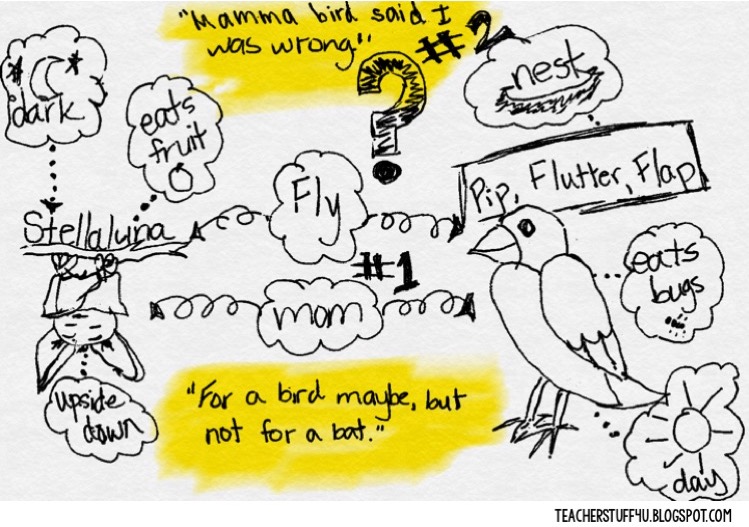
In my sketchnote example (I used the app fresh paint to create it), you can see I labeled a #1 and #2 to represent my focus during the first and second read. Sketchnotes are a great tool to use when close reading because you can easily go back to your notes and add more during successive readings. On my first read, I focused on comparing the bat Stellaluna to the birds Pip, Flutter, and Flap. I made a kind of double bubble map with their similarities and differences. 

Second Read: Figure out how the text works.

On the second read, I was focusing on the author's purpose.  When Stellaluna met other bats, she saw that they hung upside down when they slept, they ate bugs, and they flew in the dark. When the other bats asked her why she wasn't hanging upside down she said, "Mama bird said I was wrong." The other bat responded, "For a bird maybe, but not for a bat." I added this quote after my second read because I thought it was a good illustration of the author's purpose. It is also a great opportunity to apply the author's purpose to students' own lives and have a discussion about race or peer pressure. Stellaluna tried to do the "right" thing when she was in the bird's nest, but was she really doing anything wrong? How do you think that made Stellaluna feel about herself? Have you ever felt like Stellaluna where something you do is wrong in one place but not in another place (like at home)? Why do you think that is? How do you handle it?

Third Read: Analyze and compare the text.


On the third read, in my sketchnote example (created in a rocket book), I compared Stellaluna to a poem by Maya Angelou, Caged Bird. An except of this powerful poem can be found in the book Poetry for Young People: Maya Angelou. I added the quote, "The caged bird sings with a fearful trill/ of things unknown but longed for still/and his tune is heard on a distant hill/ for the caged bird sings of freedom." In this poem, the bird is in a cage and his wings are clipped and his feet are tied. It made me think of Stellaluna, and although she wasn't in a cage in the story, in a way she was caged too. She did not have the freedom to do things that came naturally to her like eat fruit and sleep upside down, and she forced herself to live in a way that didn't allow her to be herself. In this poem, it's as though the birds and Stellaluna trade places, and they know what it feels like to lack freedom. This poem is a metaphor that has implications for things students face today. There are a lot of ways that you can experience a loss of freedom. Have you ever done something because everyone else was doing it? Did it make you feel like your wings were clipped and your feet were tied? In other words, did you feel like you couldn't be yourself? 

These short texts give a lot of opportunities for deep, rich discussions, and you can capture this higher level thinking with sketchnotes. 

How will you use sketchnotes?
0

Top 3 Folktales that Integrate STEAM

This post contains affiliate links for your convenience, and at no cost to you. 

Long ago (back in 2011), when I was a second grade teacher, I wrote this post called Fairytales and Fables Unit.  In this post I focused on how to teach students the structure of fairytales and fables so that they could understand how those stories worked and use the structure to write their own fairytale or fable. It included lots of great mentor texts, ideas for aligning literacy centers, and a celebration to wrap it up–a fairytale ball! While that post is a bit dated, the idea of teaching the structural elements of these stories is still a good one that aligns with Common Core State Standards. Folktales are still a focus of the CCSS in 2nd and 3rd grade:
RL.2.2 Recount stories, including fables and folktales from diverse cultures, and determine their central message, lesson, or moral. 
RL.3.2 Recount stories, including fables, folktales, and myths from diverse cultures; determine the central message, lesson, or moral and explain how it is conveyed through key details in the text. 

Studying the structural elements of a story is also a standard in 2nd, 4th, and 5th grade:
RL2.5 Describe the overall structure of a story, including describing how the beginning introduces the story and the ending concludes the action. 
RL.4.5 Explain major differences between poems, drama, and prose, and refer to the structural elements of poems (e.g. verse, rhythm, meter) and drama (eg. casts of characters, settings, descriptions, dialogue, stage directions) when writing or speaking about a text.
RL5.5 Explain how a series of chapters, scenes, or stanzas fits together to provide the overall structure of a particular story, drama, or poem.

I love connecting STEAM (science, technology, engineering, art, math) and literacy in the classroom, so I'm going to use some of the same teaching points as the original post I wrote in 2011 with some modern updates using 3 of the best fractured folktales I have come across that highlight engineering and the design process.


VS. 


1. The Little Red Fort by Brenda Maier

This story is based on the classic fable The Little Red Hen, but in this story, Ruby is a little girl who wants to build a fort. She asks her brothers for help, but they laugh at her and tell her she can't build. Just like the original fable, Ruby works through the steps it takes to build her fort (following most of the steps in the engineering design process) while asking her brothers for help each step of the way, but they're always too busy, or just not interested until they see the fort that she made herself. 
I love that this story has diverse characters and an emphasis on STEAM! 

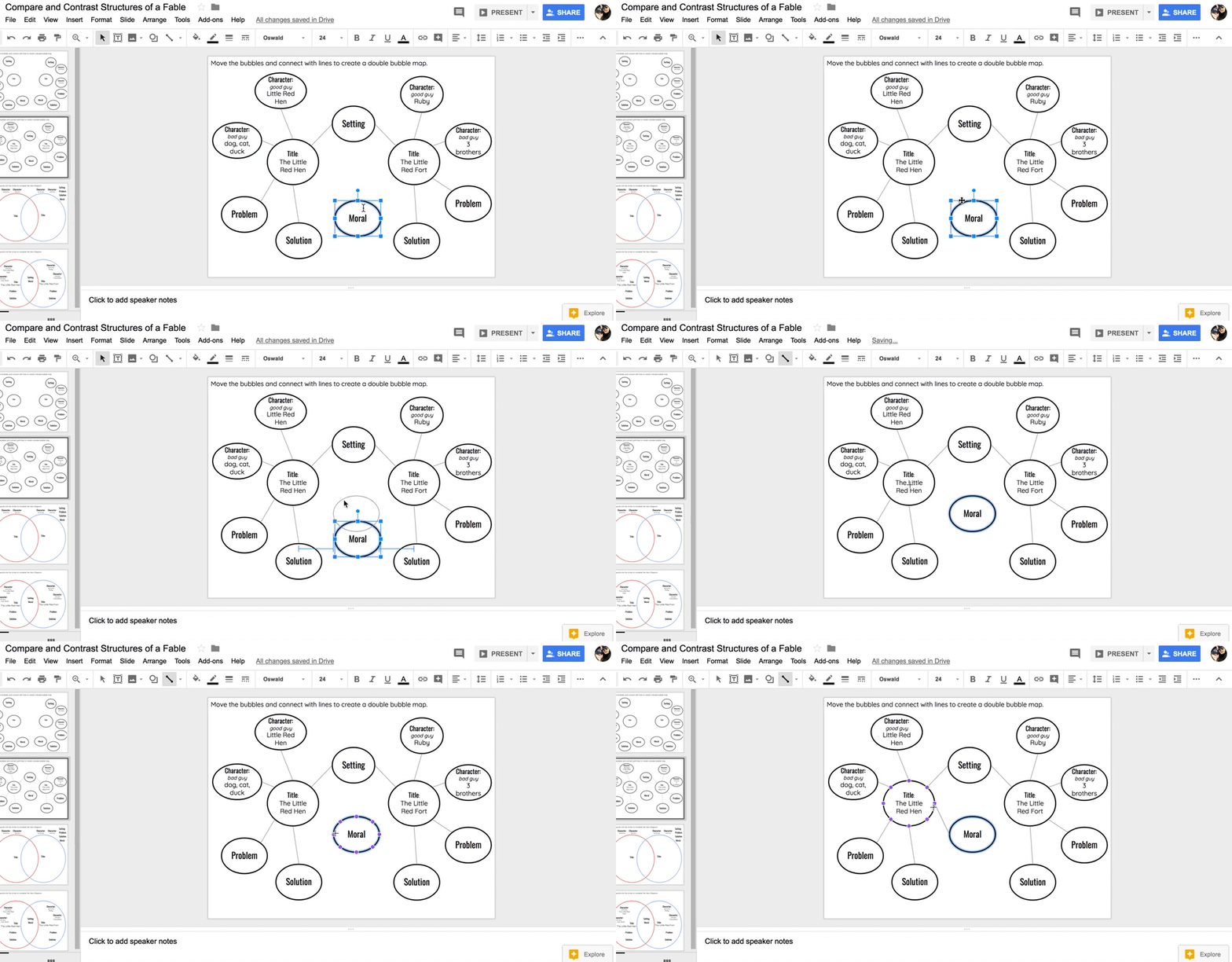
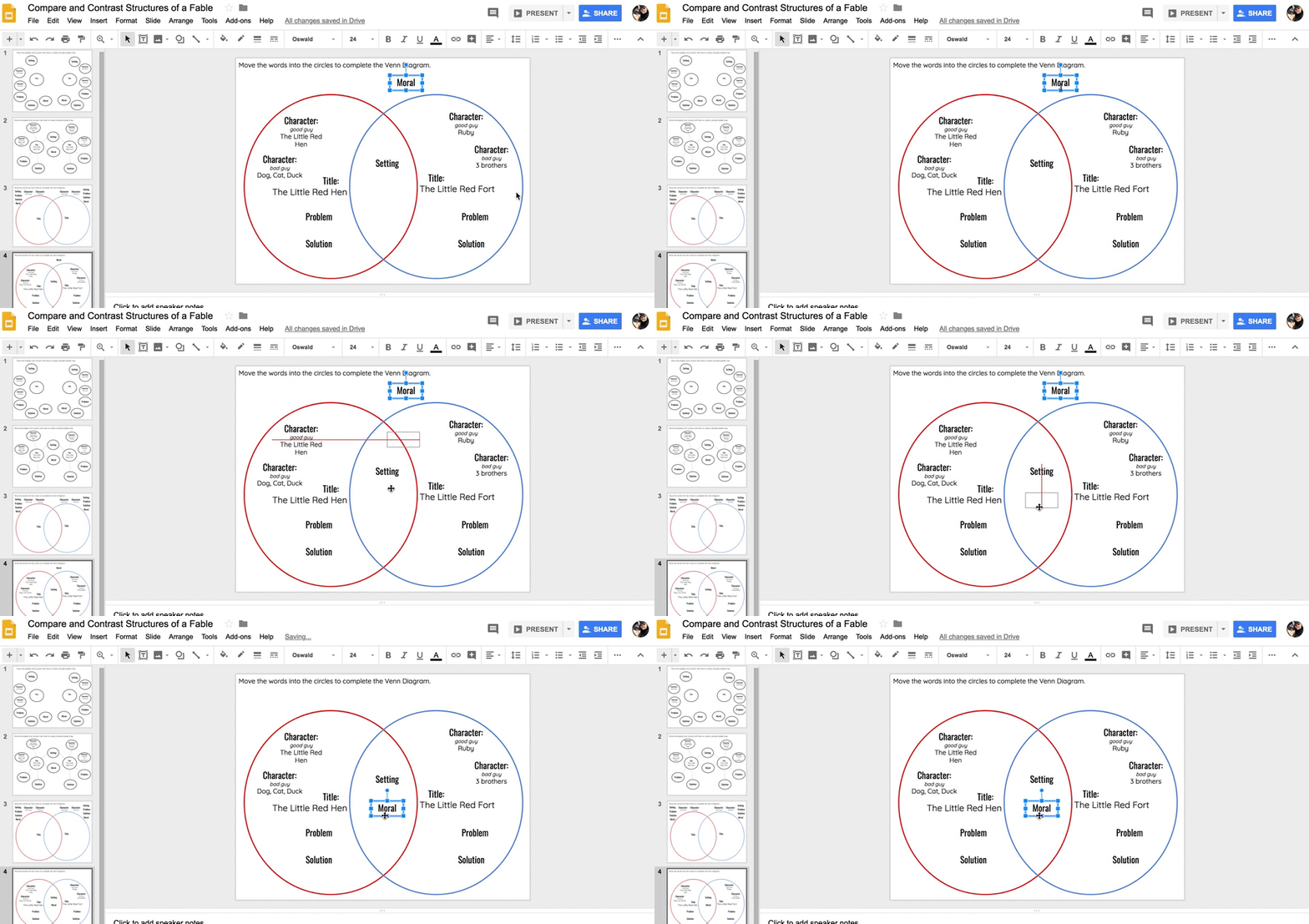
ELA lesson: Linda Dorn outlined the structures of different kinds of texts in her book Teaching For Deep Comprehension: A Reading Workshop Approach. Fill out the Structures of a Fable text map based on Linda Dorn's work after reading the original version of The Little Red Hen with your class. Next read The Little Red Fort. The google doc above is an example of how you might fill out the Structures of  a Fable text map for this book.

https://gyazo.com/c15d7c6dee2e87e469cb2d4f385c253d https://gyazo.com/886f5ded8e754873a2a8c7139e722e9b

Studying fractured fables, different versions of a classic fable, gives students a great opportunity to compare and contrast texts by analyzing stories with the same structure:
RL.2.9 Compare and contrast two or more versions of the same story (e.g., Cinderella stories) by different authors or from different cultures.
RL.3.9 Compare and contrast the themes, settings, and plots of stories written by the same author about the same or similar characters (e.g., in books from a series).
RL.4.9 Compare and contrast the treatment of similar themes and topics (e.g., opposition of good and evil) and patterns of events (e.g., the quest) in stories, myths, and traditional literature from different cultures.
RL.5.9 Compare and contrast stories in the same genre (e.g., mysteries and adventure stories) on their approaches to similar themes and topics.
Using the digital interactive notebook pages shown above, you can show students that the characters, the problem, and the solution are different, or fractured in The Little Red Fort. Instead of using animals, the main characters are human. Instead of baking bread, Ruby wants to build a fort. In the end, Ruby doesn't let her brothers play in the fort since they didn't help, but the story doesn't end there. Instead, they find ways to improve the fort, and Ruby lets them join her for a celebration inside. You can compare and contrast these stories with a double bubble map if you use Thinking Maps, or a Venn Diagram.


Engineering: This book is a great example for modeling how the Engineering Design Process works, which aligns with ISTE standard 4a: Students know and use a deliberate design process for generating ideas, testing theories, creating innovative artifacts or solving authentic problems.
According to Engineering in Elementary, to solve engineering problems, engineers follow a series of steps called the "Engineering Design Process."

ASK: What is the problem? How have others approached it? What are your constraints?
IMAGINE: What are some solutions? Brainstorm ideas. Choose the best one.
PLAN: Draw a diagram. Make lists of materials you will need.
CREATE: Follow your plan and create something. Test it out!
IMPROVE: What works? What doesn't? What could work better? Modify your design to make it better. Test it out!
In this story, Ruby asks herself and her brothers what she can build using the boards she finds (the constraints). Her brothers also tell her that she doesn't know how to build anything so she learns how (answering the question, how have others approached it?). We have to infer that she went through the imagine stage when she decided to build a fort because it is not directly stated. She plans her fort and creates it all by herself. Her brothers help her improve her fort by adding a mailbox, flowers, and painting it fire-engine red. At the end of the story, there are suggestions for building a fort of their own: a sofa fort, a kitchen chair fort, a snow fort, or a bunk-bed fort. Have students use the Engineering Design Process sheet to build a fort as homework. Using a program like Seesaw, students could even add pictures, video, and voice to illustrate how they used the Engineering Design Process to build their own fort at home.


 VS. 

2. The Three Little Pigs: An Architectural Tale by Steven Guarnaccia

This fractured folktale is a version of the classic Three Little Pigs, but their homes are made of scraps, glass, and stone and concrete. The house designs are inspired by 3 famous architects: Frank Gehry, Phillip Johnson, and Frank Lloyd Wright. Many more world-renowned designers' work is featured throughout the story, which makes this a perfect book to make a STEAM connection.


ELA lesson: This is another great story to compare and contrast to the original version of the Three Little Pigs. The Structures of a Folktale text map (above) is an example of what the structure of The Three Little Pigs: An Architectural Tale might look like. The digital interactive notebook pages show how students might compare the structures of these folktales.


This story also gives students a great opportunity for research on the 3 famous architects highlighted in this story: Frank Gehry, Phillip Johnson, and Frank Lloyd Wright. By researching the type of structures these architects create, students can get a sense for the design and artistry behind thearchitecture. 

Engineering: Now it's the students' turn to build! Using the engineering design process, have students become an architect that was hired to design a house for the three little pigs. Students must begin the Engineering Design Process by asking themselves: What will be strong enough to keep the big bad wolf from blowing it down? Is it beautiful? Using the influence of the architect they like best, students must make a plan and  create a model of their design. Give them a variety of materials to use such as cardboard, plastic cardboard screws, clear plastic bottles, and legos. Let students know that just because the concrete house in the story was the one the wolf couldn't blow down, it doesn't mean that it is the one they have to build. If they build it well, it will remain standing.


 VS.  

3. The 3 Pigs and the Scientific Wolf by Mary Fetzner

This fractured folktale is about the daughters of the 3 Little Pigs and the Big Bad Wolf's son. "He, like most children, was sure he was wiser and more clever than his father. He just knew that he could figure out an easier way to catch those delightful piglets." So the scientific wolf tries to use simple machines to catch the 3 little pigs. At the first house made of straw, he uses a pulley to try to get in. At the second house made of sticks, he tries riding a bicycle up an incline plane, and at the third house made of bricks he uses a crowbar as a lever. When that doesn't work he tries lifting the house with a corkscrew jack. He never figures out a way to get into the pigs' houses, so he decides to become a vegetarian. 

Disclaimer: I think it's important to know that this book is not a traditional book. The pictures inside the book are not in color, and pages 32 - 64 are student activity pages that outline a unit about simple machines. This book was published in 2000, and the activities at the end are not rigorous enough or hands-on enough for me, personally. I loved the idea of the wolf using simple machines so much, however, that I thought it was worth it to have the story! It opens the door for some great STEAM possibilities!

ELA lesson: Like the first two stories, fill out the Structures of a Folktale text map for this story and compare and contrast it to the original Three Little Pigs using the double bubble map or the Venn Diagram from the digital interactive notebook pages.

Engineering: Using this story and The Three Little Pigs: An Architectural Tale would be a great opportunity to create PBL unit about simple machines. 

Pulleys


Levers


Inclined Planes


Wheels and Axles


Simple Machine: The Screw

Once students have learned about simple machines, they will be hired as part of a security team to make sure that the houses they designed for the Three Little Pigs (created in The Three Little Pigs: An Architectural Tale) are safe from the scientific wolf. Their job is to try to break into their model house using simple machines just like the scientific wolf.  They will make improvements to their design until it is safe from at least 3 different attacks by the wolf. Then they will create a presentation for the 3 pigs that shows how they secured the house from 3 different simple machines that the wolf might use to get into the house. When creating their presentations, they could use iMovie, the Doink Green Screen app, or the Stop Motion Animation app. There are a lot of possibilities!

Another great connection to a simple machines unit is St. Patrick's Day STEM Challenge: Build a Leprechaun Trap with Simple Machines

After your students have designed and engineered forts, houses, and simple machines, they can use the Structures of a Fable or Folktale to create their own fractured story that includes some engineering! Maybe Jack can use simple machines to break into the giant's house, or Goldilocks gets community service for breaking into the 3 bears house, and she has to redesign the inside of their house like an episode of Fixer Upper. With lots of opportunities for hands-on learning, I'm sure the students creativity will amaze you!

The text maps, digital interactive notebooks, engineering design process sheet, and all the movies embedded in this post are available for download here on Teacher Sherpa
Enjoy!

3

Dr. Seuss Videos with QR codes

This post contains affiliate links for your convenience, for which I do receive commissions when a purchase is made, but at no cost to you.

Thursday March 2nd, 2017 is Dr. Seuss's birthday and Read Across America Day. Are you ready? I made QR codes for 8 videos of Dr. Seuss stories. Your students can use them at a listening center. I like to put the QR code inside the book so they can follow along. 

Click here to download Dr. Seuss Videos with QR codes on Teacher Sherpa!

You can also use the CCSS aligned questions in Thoughtful Log entries as higher level thinking response to literature. I wrote a blog post about how to use them here. Here are some Thoughtful Log Entry examples that you could use with these Dr. Seuss stories:

Green Eggs and Ham


Thoughtful Log Entry Question:
How would you describe the main characters in the story? What is he/she like? What did he/she do in the story to make you describe the character this way?

CCSS RL.2.1, 3.1, 3.3, 4.1

Thoughtful Log Entry Question:
How did the character (Sam I am) respond to the problem? (He could not get the other character in the story to eat green eggs and ham) Why did he/she act this way? Use evidence from the text to support your answer.
CCSS RL.2.3, 3.3, 4.3

Thoughtful Log Entry Question:
Which words in the text rhyme? How does that supply rhythm and meaning to the way you read it?
CCSS RL.2.4

Thoughtful Log Entry Question:
Which words provide the text with regular beats? How does it effect the way you read it?
CCSS RL.2.4

Thoughtful Log Entry Question:
Which lines in the text repeat? How does that supply rhythm and meaning to the way you read it?
CCSS RL.2.4

The Sneetches

Thoughtful Log Entry Question:
What is the theme of this story? Use evidence from the text to support your answer.
CCSS RL.2.1, 3.1, 4.2

Thoughtful Log Entry Question:
What is the central message, lesson, or moral of the story? Use evidence from the text to support your answer.
CCSS RL.1.1, 2.2, 3.2

Thoughtful Log Entry Question:
When did this story take place? What evidence from the text makes you think so? 
CCSS RL.1.3, 2.1, 3.1, 4.1
(It could be argued that this story is taking place today. We have problems in the world today that could be compared and contrasted to this story. It could also be argued that it took place in the past. This story could be compared and contrasted with reasons that war broke out in the past.) 

Thoughtful Log Entry Question:
Why do you think the author wrote this text?
CCSS RL.2.1, 3.1, 4.1

Thoughtful Log Entry Question:
Describe the overall structure of the story:
Beginning introduces the story
Setting
Major Events
Ending concludes the story
CCSS RL.1.3, 2.5

Thoughtful Log Entry Question:
Does any part of this book (characters, settings, problem, theme, plot) remind you of another story? How? Use evidence from both texts to support your answer.
CCSS RL1.9, .2.9, 3.9
(This story's plain belly Sneetches could be compared to the character The Lorax. Both characters have an opinion that is not very popular and they are not treated well due to their beliefs.)

The Zax

Thoughtful Log Entry Question:
How would you describe the main characters in the story? What is he/she like? What did he/she do in the story to make you describe the character this way?
CCSS RL.2.1, 3.1, 3.3, 4.1

Thoughtful Log Entry Question:
What is the theme of this story? Use evidence from the text to support your answer.
CCSS RL.2.1, 3.1, 4.2

Thoughtful Log Entry Question:
What is the central message, lesson, or moral of the story? Use evidence from the text to support your answer.
CCSS RL.1.1, 2.2, 3.2


Thoughtful Log Entry Question:
How did the character respond to the problem? Why did he/she act this way? Use evidence from the text to support your answer.
CCSS RL.2.3, 3.3, 4.3

Thoughtful Log Entry Question:
Would you respond in the same way as the character in this story? Why or why not?
CCSS RL.3.6

Thoughtful Log Entry Question:
Why do you think the author wrote this text?

CCSS RL.2.1, 3.1, 4.1

Ten Apples Up On Top

Thoughtful Log Entry Question:
Which words in the text rhyme? How does that supply rhythm and meaning to the way you read it?
CCSS RL.2.4

Thoughtful Log Entry Question:
Which words provide the text with regular beats? How does it effect the way you read it?
CCSS RL.2.4

Thoughtful Log Entry Question:
Which lines in the text repeat? How does that supply rhythm and meaning to the way you read it?
CCSS RL.2.4

Thoughtful Log Entry Question:
Record yourself reading the text aloud (or part of the text) and use different voices for each character.
CCSS RL.2.6

Dr. Seuss' ABC

Thoughtful Log Entry Question:
Which words provide the text with alliteration? How does that supply rhythm and meaning to the way you read it?
CCSS RL.2.4

Thoughtful Log Entry Question:
Which words provide the text with regular beats? How does it effect the way you read it?
CCSS RL.2.4

Thoughtful Log Entry Question:
Which lines in the text repeat? How does that supply rhythm and meaning to the way you read it?
CCSS RL.2.4

Thoughtful Log Entry Question:
Record yourself reading the text aloud (or part of the text) and use different voices for each character.
CCSS RL.2.6

Hop on Pop

Thoughtful Log Entry Question:
Which words in the text rhyme? How does that supply rhythm and meaning to the way you read it?
CCSS RL.2.4

Thoughtful Log Entry Question:
Which words provide the text with regular beats? How does it effect the way you read it?
CCSS RL.2.4

Thoughtful Log Entry Question:
Which lines in the text repeat? How does that supply rhythm and meaning to the way you read it?
CCSS RL.2.4

Thoughtful Log Entry Question:
Record yourself reading the text aloud (or part of the text) and use different voices for each character.
CCSS RL.2.6

The Lorax

Thoughtful Log Entry Question:
How would you describe the main character in the story? What is he/she like? What did he/she do in the story to make you describe the character this way?
CCSS RL.2.1, 3.1, 3.3, 4.1

Thoughtful Log Entry Question:
What is the theme of this story? Use evidence from the text to support your answer.
CCSS RL.2.1, 3.1, 4.2

Thoughtful Log Entry Question:
What is the central message, lesson, or moral of the story? Use evidence from the text to support your answer.
CCSS RL.1.1, 2.2, 3.2

Thoughtful Log Entry Question:
How did the character respond to the problem? Why did he/she act this way? Use evidence from the text to support your answer.
CCSS RL.2.3, 3.3, 4.3

Thoughtful Log Entry Question:
Would you respond in the same way as the character in this story? Why or why not?
CCSS RL.3.6

Thoughtful Log Entry Question:
What does this word or phrase from the story mean? (Thneed)
What evidence from the text makes you think so?
CCSS RL.4.4

Thoughtful Log Entry Question:
Why do you think the author wrote this text?
CCSS RL.2.1, 3.1, 4.1

Thoughtful Log Entry Question:
Describe the overall structure of the story:
Beginning introduces the story
Setting
Major Events
Ending concludes the story
CCSS RL.1.3, 2.5

Thoughtful Log Entry Question:
Who is telling the story? How do you know? Use evidence from the text to support your answer.
CCSS RL.1.6, 2.6, 4.6

Thoughtful Log Entry Question:
How is this story similar to another story? Use evidence from both texts to support your answer.
CCSS RL.2.9, 3.9
(This book could be compared to Just A Dream by Chris Van Allsburg)
Thoughtful Log Entry Question:
Does any part of this book (characters, settings, problem, theme, plot) remind you of another story? How? Use evidence from both texts to support your answer.
CCSS RL1.9, .2.9, 3.9

Horton Hears A Who

Thoughtful Log Entry Question:
How would you describe the main character in the story? What is he/she like? What did he/she do in the story to make you describe the character this way?
CCSS RL.2.1, 3.1, 3.3, 4.1

Thoughtful Log Entry Question:
What is the theme of this story? Use evidence from the text to support your answer.
CCSS RL.2.1, 3.1, 4.2

Thoughtful Log Entry Question:
What is the central message, lesson, or moral of the story? Use evidence from the text to support your answer.
CCSS RL.1.1, 2.2, 3.2

Thoughtful Log Entry Question:
How did the character respond to the problem? Why did he/she act this way? Use evidence from the text to support your answer.
CCSS RL.2.3, 3.3, 4.3

Thoughtful Log Entry Question:
Would you respond in the same way as the character in this story? Why or why not?
CCSS RL.3.6

Thoughtful Log Entry Question:
Why do you think the author wrote this text?
CCSS RL.2.1, 3.1, 4.1

Thoughtful Log Entry Question:
Describe the overall structure of the story:
Beginning introduces the story
Setting
Major Events
Ending concludes the story
CCSS RL.1.3, 2.5

Click here to download Dr. Seuss Videos with QR codes on Teacher Sherpa

Click here to download Thoughtful Log Entries

Enjoy!


1