Teacher Stuff: close reading

Showing posts with label close reading. Show all posts

Close Reading with Sketchnotes

Have you heard of sketchnotes? This visual note-taking technique uses pictures, words, arrows, lines, and doodles to capture a main idea, and you don't have to be an artist to do it! Sketchnotes are not about art, but about triggering both sides of your brain to help you remember important ideas using visual cues to highlight information. This technique requires a deep understanding and synthesizing of information in order to capture the big ideas. 

I see similarities between the concept of sketchnotes and book snaps, one of my new favorite ways of having students interact with text, and I fully intend to mesh these two strategies together this year!

Introducing Sketchnotes to Students

To introduce the concept of sketchnoting to students, we started with a low-stakes assignment where students got to share something about themselves. With a new concept and/or a new tool, it's important to give students time to experiment before asking them to do something that has a lot of heavy content. Think about your level of anxiety if you were in a class that asked you to use a technology tool you had never used before, and you were told you had to complete a high stakes assignment that you would be graded on the first time you ever used it. Yikes! The time spent "playing" around with it so you can figure out how it works is well worth the time spent so you know how to use it later when heavier content is layered in. When you're familiar with the tool you are using to create something, it frees up working memory to focus on your ideas rather than how to use the tool.

We introduced sketchnotes with a short video: Sketchnote Frenzy: The Basics of Visual Note-taking.


I created the sketchnote above digitally proving that you don't have to be an artist to try sketchnoting! I got the idea for the 4Cs sketchnote from Expressive Monkey's Sketchnote Toolbox on TpT. Here is her blog post: The Visual Structure of Sketchnotes.  We began with sharing what we did over the summer through the 4Cs. We started by putting our names in the middle, and in the upper right hand corner, we chose something important we wanted to communicate. In my example, I shared about the opportunity I had to take a tour of Google in Boulder, CO. It was amazing!  In the lower right hand corner, we shared something creative we did. This summer I became Raspberry Pi certified, and I learned how to do a lot of sophisticated programming. My picture shows a Raspberry Pi and the lights I programmed like a stop light. In the upper left hand corner, we shared people with whom we have collaborated. I went to two different conferences this summer, so in my example, I listed the teachers who came with me to those conferences. In the lower left hand corner, we used critical thinking to start brainstorming ideas for genius hour. Students wrote what they were interested in learning more about.

Technology Options for Sketchnotes

If you're using a windows 10 device, these apps are great for sketchnoting:
If you're using an iPad, these are my favorite apps:
  • Paper 53 
  • Book Creator – this is not a drawing app, but it has the potential for adding drawings, pictures, voices, and even videos in an ebook making it a much more dynamic way to create a sketchnote!
  • SeeSaw – this is another tool that is not a drawing app, but it has the potential to add drawings, pictures, voice, and create videos and put them into a digital portfolio. Another great tool for creating dynamic sketchnotes!
  • Pic Collage EDU – this tool is for making collages with pictures, but it also has the ability to add drawings, words, and pictures. Check out this post from Erintegration: Drawing on Pic Collage with A Simple Hack.  
  • Popplet – this is another tool that is not a drawing app–it's actually a visual mind-mapping tool or graphic organizer that has the functionality to add pictures, videos, words, or drawings to organize your thoughts or data. Popplet can be used on the iPad or computer.


If you don't have access to a classroom set of devices or you prefer to write/draw with a pencil and paper, there is still a technology option for you that I'm SO excited about! I recently learned about Rocket books. These notebooks look and feel like real paper that use Frixion Erasable pens or markers (some of my favorite!). You can add your sketchnotes into the notebook, then scan it with the rocketbook app and send it straight to your google drive, dropbox, email, or even send it in a text (which is great for my son when he wants to send his picture to grandma and grandpa!). Once you have saved your sketchnote digitally, put your notebook in the microwave with a mug of water on top of it, and it wipes all the pages clean so you can use them all over again! Amazing! These notebooks are pricer than regular notebooks, but if they hold up, they can be reused over and over by different classes each year. I'm writing a grant for a couple of class sets so I can test that theory. I'll keep you posted on how that experiment goes . . . 


Close Reading with Sketchnotes
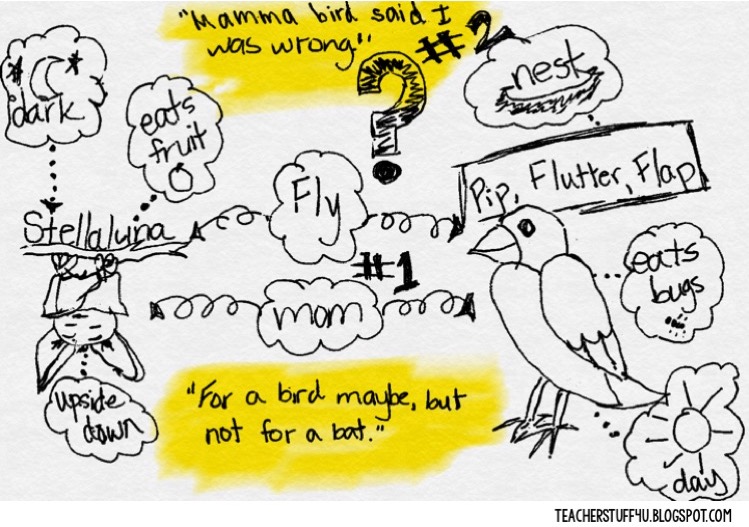

Now we're ready to jump into content using sketchnotes. I chose the picture book Stellaluna by Janell Cannon. According to the article Closing in on Close Reading in ASCD's Educational Leadership, "When students are learning a process, such as how to search for a recurring theme, reading short texts allows them to make more passes through the entire sequence of a text. It could take weeks or even months to read through a 100-page novel to identify a theme or concepts related to the text as a whole. A short text of a page or two can be digested in one lesson."


Stellaluna was a bat that landed in a bird's nest when she was just a baby after falling out of her mama's grasp during an owl attack. Stellaluna was raised by the mama bird, and although she had some similarities to her adopted bird family, she did not always act like her bird brothers. Stellaluna did not like to eat bugs, she had trouble flying and landing during the day, and she liked to sleep hanging upside down by her feet. After her three bird brothers tried hanging upside down by their feet too, mama bird told Stellaluna that she would have to stop teaching the other birds bad habits if she wanted to stay in that nest. Later Stellaluna meets other bats, and she discovers that she was not wrong, she was just different than her bird family. But in the end, they can all still be friends despite their differences. 

First Read: Determine what the text says.

In my sketchnote example (I used the app fresh paint to create it), you can see I labeled a #1 and #2 to represent my focus during the first and second read. Sketchnotes are a great tool to use when close reading because you can easily go back to your notes and add more during successive readings. On my first read, I focused on comparing the bat Stellaluna to the birds Pip, Flutter, and Flap. I made a kind of double bubble map with their similarities and differences. 

Second Read: Figure out how the text works.

On the second read, I was focusing on the author's purpose.  When Stellaluna met other bats, she saw that they hung upside down when they slept, they ate bugs, and they flew in the dark. When the other bats asked her why she wasn't hanging upside down she said, "Mama bird said I was wrong." The other bat responded, "For a bird maybe, but not for a bat." I added this quote after my second read because I thought it was a good illustration of the author's purpose. It is also a great opportunity to apply the author's purpose to students' own lives and have a discussion about race or peer pressure. Stellaluna tried to do the "right" thing when she was in the bird's nest, but was she really doing anything wrong? How do you think that made Stellaluna feel about herself? Have you ever felt like Stellaluna where something you do is wrong in one place but not in another place (like at home)? Why do you think that is? How do you handle it?

Third Read: Analyze and compare the text.


On the third read, in my sketchnote example (created in a rocket book), I compared Stellaluna to a poem by Maya Angelou, Caged Bird. An except of this powerful poem can be found in the book Poetry for Young People: Maya Angelou. I added the quote, "The caged bird sings with a fearful trill/ of things unknown but longed for still/and his tune is heard on a distant hill/ for the caged bird sings of freedom." In this poem, the bird is in a cage and his wings are clipped and his feet are tied. It made me think of Stellaluna, and although she wasn't in a cage in the story, in a way she was caged too. She did not have the freedom to do things that came naturally to her like eat fruit and sleep upside down, and she forced herself to live in a way that didn't allow her to be herself. In this poem, it's as though the birds and Stellaluna trade places, and they know what it feels like to lack freedom. This poem is a metaphor that has implications for things students face today. There are a lot of ways that you can experience a loss of freedom. Have you ever done something because everyone else was doing it? Did it make you feel like your wings were clipped and your feet were tied? In other words, did you feel like you couldn't be yourself? 

These short texts give a lot of opportunities for deep, rich discussions, and you can capture this higher level thinking with sketchnotes. 

How will you use sketchnotes?
0

Introducing Close Reading Strategies at the Beginning of the Year

This post contains affiliate links for your convenience, for which I do receive commissions if a purchase is made, but at no cost to you.

According to Beth Burke, NBCT, “Close reading is thoughtful, critical analysis of a text that focuses on significant details or patterns in order to develop a deep, precise understanding of the text’s form, craft, meanings, etc. It is a key requirement of the Common Core State Standards and directs the reader’s attention to the text itself.”  She also says that texts used for close readings should be short, they should be discussed in large or small groups, and they need to be deliberately reread at least 3 times. 
With those key points in mind, short films and wordless picture books are a great way to introduce the strategies involved in close reading. Like wordless picture books, there are short films that have no words, but the content is definitely discussion worthy. Taking out the decoding to focus on the content and thoughtful discussion will allow every student to be able to access the content and practice the strategies involved in close reading. 

The short film For the Birds by Pixar is a great place to start. It addresses the subject of bullying, which is a great discussion to have at the beginning of the year. 

First Read
When doing a close read, students focus on what the text says first by identifying what the story is mostly about. They can look for the main idea, summarize, or find the theme. If your students are identifying a theme, remember that the subject and the theme aren't the same thing. Bullying, for example, is not a theme. it's a subject.  A universal theme about bullying might be Overcoming Adversity; someone overcomes the problems they face with bullies. Another common theme might include Man vs. Society. The reason someone might bully another person could be from peer pressure, and they are trying to fit in by joining in the bullying. Students can come up with their own theme too by giving an opinion about the subject, such as: bullies always get their pay backs. This video helps introduce how to find a theme:

Second Read
On the second read, students focus on how the text works by looking at text
structures and text features. They might also focus on the author's craft or
what the text says by looking at vocabulary or word choice. 

Still using the short film For the Birds, have students think about what words
they would use to describe the birds. Have them use evidence from the film to 
support their thinking. Here is the video again, but with comments embedded to
help students think about the birds character traits :


Third Read
Students focus on a deeper understanding of what the text means 
by inferring, analyzing, and evaluating the text on the third read. They might
compare it to another text or connect it to the larger world with text to self 
connections, text to text, text to media, or text to world connections. 


With this short film, on the third read have students make a connection to your
classroom. How can you address bullying in your classroom? You can also 
compare this short film to the wordless picture Bluebird by Bob Staake. Just like
the short film, this picture book has no words, but it is definitely discussion
worthy. Every student will be able to access the content and deep thinking, and 
this book is intense. The story is a very sad one that includes death, so you may
want to preview it first to make sure it is not too intense for your class. I am 
including the book trailer for this book, but a video does not do it justice, so 
you'll want to look at a copy of this powerful wordless picture book yourself. 


You can download this lesson on Teacher Sherpa. It includes QR codes and links to all the videos in this post so you can use it with iPads or laptops/chromebooks. It also includes the text dependent questions for the first read, the second read, and 2 options for the third read, along with blank pages to use with your own books and/or videos. 
 

How do you introduce close reading in your classroom? I hope you'll consider using short films and wordless picture books to kick it off in your classroom. They're a great tool that will allow you to have deep conversations regardless of a students' reading level. Enjoy!


0

Easter/Spring Read Alouds with QR Codes

This post contains affiliate links for your convenience, for which I do receive commissions if a purchase is made, but at no cost to you.

It's that time of year to start sharing stories about Easter and Spring time in your classroom! Here are some Read Alouds that you can add to your listening center. You can download the QR codes for students to scan. You can also pair these stories with Thoughtful Log Entry questions for higher level thinking with these stories.

Click here to download the QR codes for these stories.


Rose's Garden


Thoughtful Log Entry Question:
How would you describe the main character in the story? What is he/she like? What did he/she do in the story to make you describe the character this way?

CCSS RL.2.1, 3.1, 3.3, 4.1

Thoughtful Log Entry Question:
What is the central message, lesson, or moral of the story? Use evidence from the text to support your answer.
CCSS RL.1.1, 2.2, 3.2

Thoughtful Log Entry Question:
How did the character respond to the problem? Why did he/she act this way? Use evidence from the text to support your answer.
CCSS RL.2.3, 3.3, 4.3

Thoughtful Log Entry Question:
Describe the overall structure of the story:
Beginning introduces the story
Setting
Major Events
Ending concludes the story
CCSS RL.1.3, 2.5

Thoughtful Log Entry Question:
How is this story similar to another story? Use evidence from both texts to support your answer. 
(possible stories to compare: The Curious Garden, Plant a Kiss -- a read aloud book you can find in the Valentine's Day QR codes download, and Miss Rumphius)
CCSS RL.2.9, 3.9 

The Curious Garden


Thoughtful Log Entry Question:
How would you describe the main character in the story? What is he/she like? What did he/she do in the story to make you describe the character this way?
CCSS RL.2.1, 3.1, 3.3, 4.1

Thoughtful Log Entry Question:
What is the theme of this story? Use evidence from the text to support your answer.
CCSS RL.2.1, 3.1, 4.2

Thoughtful Log Entry Question:
What is the central message, lesson, or moral of the story? Use evidence from the text to support your answer.
CCSS RL.1.1, 2.2, 3.2

Thoughtful Log Entry Question:
How is this story similar to another story? Use evidence from both texts to support your answer.
(possible stories to compare: Rose's Garden, Plant a Kiss -- a read aloud book you can find in the Valentine's Day QR codes download, and Miss Rumphius)

CCSS RL.2.9, 3.9

The Tiny Seed


Thoughtful Log Entry Question:
When did this story take place? What evidence from the text makes you think so? (This could be a season)
CCSS RL.1.3, 2.1, 3.1, 4.1

Thoughtful Log Entry Question:
Where does the story take place? What evidence from the text makes you think so?
CCSS RL.1.3, 2.1, 3.1, 4.1

The Easter Egg


Thoughtful Log Entry Question:
How would you describe the main character in the story? What is he/she like? What did he/she do in the story to make you describe the character this way?

CCSS RL.2.1, 3.1, 3.3, 4.1

Thoughtful Log Entry Question:
What is the theme of this story? Use evidence from the text to support your answer.
CCSS RL.2.1, 3.1, 4.2

Thoughtful Log Entry Question:
When did this story take place? What evidence from the text makes you think so? (You could focus on the time of year, March, April because of the weather and because it's near Easter time.)
CCSS RL.1.3, 2.1, 3.1, 4.1

Thoughtful Log Entry Question:
How did the character respond to the problem? Why did he/she act this way? Use evidence from the text to support your answer.
CCSS RL.2.3, 3.3, 4.3

Thoughtful Log Entry Question:
Would you respond in the same way as the character in this story? Why or why not?
CCSS RL.3.6
The Velveteen Rabbit


Thoughtful Log Entry Question:
How would you describe the main character in the story? What is he/she like? What did he/she do in the story to make you describe the character this way?
CCSS RL.2.1, 3.1, 3.3, 4.1

Thoughtful Log Entry Question:
What is the theme of this story? Use evidence from the text to support your answer.
CCSS RL.2.1, 3.1, 4.2

Thoughtful Log Entry Question:
How did the character respond to the problem? Why did he/she act this way? Use evidence from the text to support your answer.
CCSS RL.2.3, 3.3, 4.3

Thoughtful Log Entry Question:
Would you respond in the same way as the character in this story? Why or why not?
CCSS RL.3.6

Thoughtful Log Entry Question:
Who is telling the story? How do you know? Use evidence from the text to support your answer.
CCSS RL.1.6, 2.6, 4.6

I'm Not Hatching


Thoughtful Log Entry Question:
How would you describe the main character in the story? What is he/she like? What did he/she do in the story to make you describe the character this way?
CCSS RL.2.1, 3.1, 3.3, 4.1

Thoughtful Log Entry Question:
How did the character respond to the problem? Why did he/she act this way? Use evidence from the text to support your answer.
CCSS RL.2.3, 3.3, 4.3

Here Comes Easter Cat


Thoughtful Log Entry Question:
How would you describe the main character in the story? What is he/she like? What did he/she do in the story to make you describe the character this way?
CCSS RL.2.1, 3.1, 3.3, 4.1

Thoughtful Log Entry Question:
How did the character respond to the problem? Why did he/she act this way? Use evidence from the text to support your answer.
CCSS RL.2.3, 3.3, 4.3

Thoughtful Log Entry Question:
Who is telling the story? How do you know? Use evidence from the text to support your answer.
CCSS RL.1.6, 2.6, 4.6

Thoughtful Log Entry Question:
Analyze one of the pictures or illustrations in the text. What does it tell you about the (characters, setting, events, plot, mood) of the story? (Circle one.) (I would circle mood --- the cat has great expressions that tell the story.)
CCSS RL.1.7, 2.7, 3.7

My Garden


Thoughtful Log Entry Question:
Where does the story take place? What evidence from the text makes you think so?
CCSS RL.1.3, 2.1, 3.1, 4.1

Thoughtful Log Entry Question:
Who is telling the story? How do you know? Use evidence from the text to support your answer.
CCSS RL.1.6, 2.6, 4.6

Thoughtful Log Entry Question:
Analyze one of the pictures or illustrations in the text. What does it tell you about the (characters, setting, events, plot, mood) of the story? (Circle one.)
CCSS RL.1.7, 2.7, 3.7

Egg


Thoughtful Log Entry Question:
Analyze one of the pictures or illustrations in the text. What does it tell you about the (characters, setting, events, plot, mood) of the story? (Circle one.)
CCSS RL.1.7, 2.7, 3.7


Enjoy!


0